Enter your max to calculate all 12 workouts in the 3-week Smolov Jr bench press or squat program, including percentages, weekly increases and plate-ready weights in kg or lb.
Bench Press Smolov Jr Program for 100.0kg 1RM
Bench Press Smolov Jr Plan
3 Weeks12 Sessions
1RM: 100.0kg ·
Weekly increment: 5.0kg ·
Round to: 2.5kg
Copy the exact setup link, save a polished PDF, or download all 12 sessions as a spreadsheet-friendly CSV.
About This Smolov Jr Calculator
Smolov Jr is a short, high-frequency strength block: 3 weeks, 4 sessions per week, usually for bench press or squat.
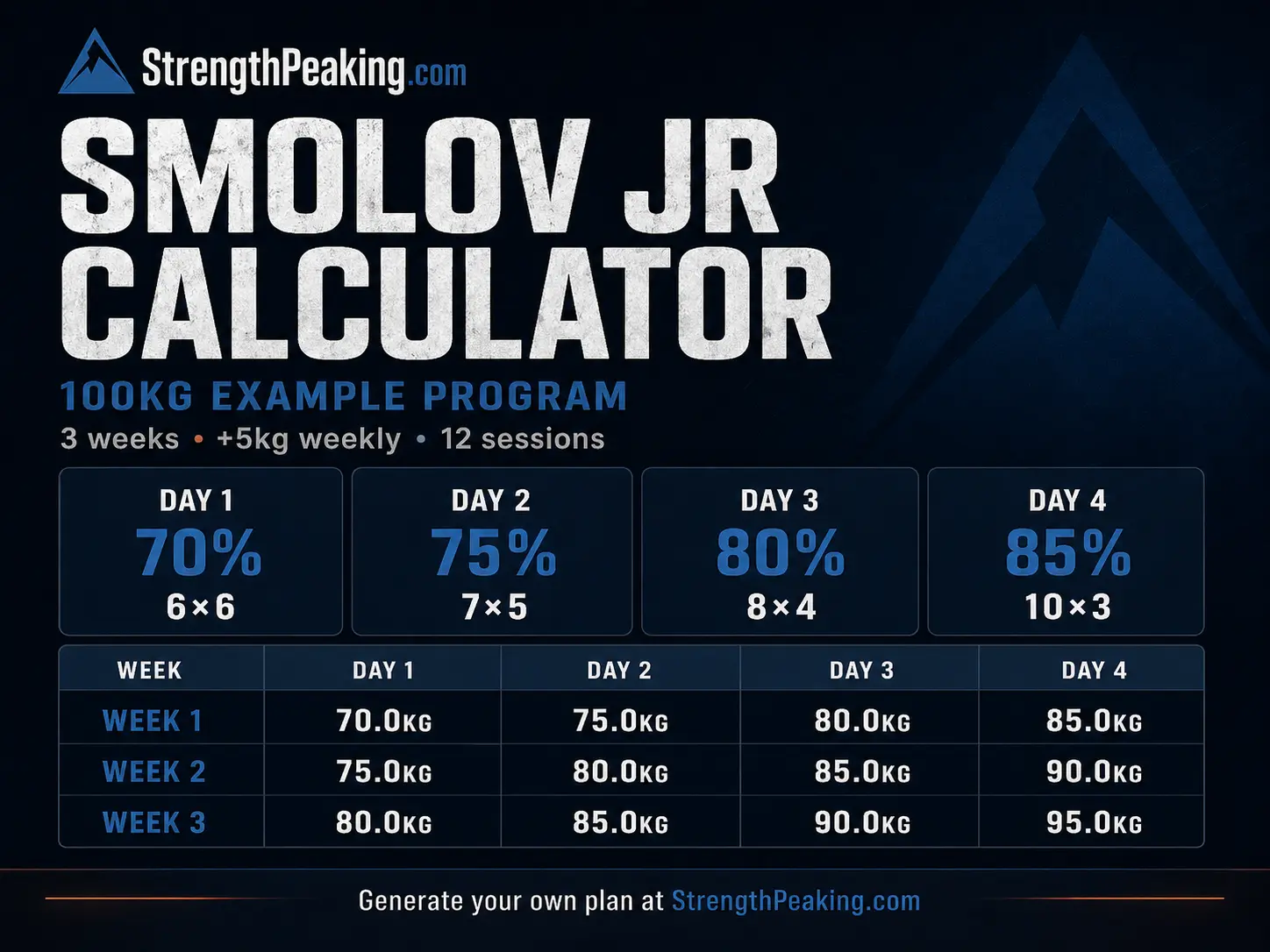
The standard layout is 6×6 at 70%, 7×5 at 75%, 8×4 at 80% and 10×3 at 85%. Week 2 adds your selected increment. Week 3 adds twice that increment.
This is a demanding program. Use a realistic 1RM, avoid grinding early sessions and adjust the loads if recovery or technique drops off.
Program guide
How the Smolov Jr Program Works
Smolov Jr is a 3-week specialization block for one lift, normally the bench press or squat. You perform the same lift 4 times per week for 12 total workouts. The set and rep pattern repeats each week while the working weight increases. It is short, simple and very demanding; it is not a general full-body routine.
Smolov Jr sets, reps and percentages
Week 1 Smolov Jr workout structure
Workout
Sets × reps
Base percentage
Total reps
Day 1
6 × 6
70%
36
Day 2
7 × 5
75%
35
Day 3
8 × 4
80%
32
Day 4
10 × 3
85%
30
Across the full cycle that is 93 working sets and 399 working reps on one lift. Warm-up sets are separate and are not included in the calculator's volume total.
How This Smolov Jr Calculator Calculates Your Weights
Choose bench press or squat, enter a one-rep max or training max, select kg or lb, then set a weekly increase and a plate-friendly rounding increment. The calculation for each workout is:
Week 1: entered max × base percentage Week 2: (entered max × base percentage) + one weekly increase Week 3: (entered max × base percentage) + two weekly increases
The final number is rounded to the increment you select. For example, with a 100kg max, a 5kg weekly increase and 2.5kg rounding, Day 1 progresses from 70kg in Week 1 to 75kg in Week 2 and 80kg in Week 3. Use the generated table or week-card view for the complete 12-workout plan.
A 100kg example with 5kg weekly increases. Your result may differ after rounding to available plates.
Should You Enter a True 1RM or a Training Max?
Enter a number you could reproduce today with sound technique. A recent, reliable 1RM can work for an experienced lifter with good recovery, but it should not be a lifetime best from a different bodyweight or a lift completed with questionable form. An inflated max makes every one of the 12 sessions too heavy.
A conservative training max is often the better choice if your 1RM is old, estimated or affected by fatigue. One simple option is to enter about 90% of your best lift, but that is a starting point rather than a rule. If you do not know your current max, estimate it with the 1RM calculator and then round down.
Choosing the Weekly Increase
Common weekly increases are 2.5–5kg or 5–10lb. Bench press usually suits the smaller end of that range because the absolute working weights are lower. Some lifters can tolerate the larger increase for squat, but the correct choice depends on your max, training history and recovery—not on the number you hope to add at the end of the cycle.
Treat the increase as adjustable. If Week 1 is already slow or technique begins to break down, calculate the remaining weeks again with a smaller increase. Starting with the smaller jump leaves room to complete the program; choosing an aggressive jump can turn Week 3 into repeated missed reps.
Smolov Jr Schedule and Rest Days
The classic schedule is Monday, Wednesday, Friday and Saturday. That creates a rest day after the first two workouts, places the final two sessions on consecutive days and gives two days before the next week starts. The exact weekdays can move, but keep the same rhythm rather than compressing missed workouts together.
Take enough rest between working sets to keep technique and bar speed consistent. Three to five minutes is a practical range for many lifters, and harder sets may need longer. This is percentage-based strength work, not a conditioning circuit. If you cannot train 4 days per week or regularly recover between sessions, a lower-frequency program is a better fit.
Bench Press vs Squat Smolov Jr
The calculator uses the familiar 6×6, 7×5, 8×4 and 10×3 template for both lifts. For bench press, monitor shoulder, elbow and pec fatigue and keep additional pressing modest. Rows and easy upper-back work can be retained if they do not reduce the quality of the main sessions.
Squat Smolov Jr creates more whole-body fatigue. Reduce extra lower-body volume, especially hard deadlifts, heavy hinges and high-rep leg work. Run the cycle for one priority lift at a time; attempting the full template for bench and squat simultaneously makes recovery much harder and defeats the purpose of specialization.
What to Do if You Miss Reps
Do not add unplanned sets to make up every missed repetition. If one set is poor, extend the rest period and judge whether another clean set is realistic. Stop the workout if technique continues to deteriorate or pain changes the movement. For the next session, repeat the weight or recalculate with a smaller entered max or weekly increase.
A missed workout is also not a reason to double up. Resume after adequate recovery and preserve the order of the sessions. If the calendar no longer allows four quality workouts, extending the cycle by a few days is preferable to forcing high-volume sessions while fatigued.
Accessories, Recovery and Testing After the Cycle
Keep accessories at maintenance volume. Choose a small amount of work that supports the main lift without creating soreness or joint irritation, and avoid taking accessory sets to failure. Consistent sleep, adequate food and stable bodyweight make this block easier to recover from; a demanding calorie deficit is a poor time to run it.
After Week 3, let accumulated fatigue fall before testing a new max. Use several easy sessions or a deload and test when soreness has settled and normal bar speed has returned. Smolov Jr does not guarantee a particular increase: the best result may be a larger max, better technique under heavier loads or clear evidence that a different program suits you better.
Smolov Jr Calculator FAQs
What is Smolov Jr?
Smolov Jr is a 3-week, 4-day-per-week specialization cycle for one lift. It repeats 6×6, 7×5, 8×4 and 10×3 workouts each week while increasing the load in Weeks 2 and 3.
How does this Smolov Jr calculator work?
Enter a one-rep max or conservative training max, choose kg or lb, set the weekly increase and rounding increment, then calculate. The calculator applies 70%, 75%, 80% and 85% in Week 1, adds one increment in Week 2 and two increments in Week 3.
Should I use my true 1RM or a training max for Smolov Jr?
Use a number you can reproduce with sound technique. Experienced lifters with a recent, reliable max may use their true 1RM, but a conservative training max is often more manageable across 12 high-volume sessions.
What weekly increase should I use for Smolov Jr?
A common range is 2.5–5kg or 5–10lb. Bench press usually suits the smaller end of the range, while some lifters can use a larger increase for squat. Choose the smaller jump when in doubt and adjust after each week if needed.
What should I do if I miss reps on Smolov Jr?
Do not add extra sets to chase missed repetitions. End the session if technique is deteriorating, then repeat the load or recalculate the remaining weeks with a smaller max or weekly increase.
Can beginners use Smolov Jr?
It is generally a poor fit for beginners. Newer lifters can usually progress with a simpler program that develops technique without 4 high-volume sessions on the same lift every week.
Can I use Smolov Jr for deadlifts?
The common Smolov Jr template is used for bench press or squat. Four high-volume deadlift sessions per week create substantial fatigue, so this calculator does not offer a deadlift option. Consider a lower-frequency plan such as the 5/3/1 calculator instead.
Can I run Smolov Jr for bench and squat together?
The program is intended to specialize in one lift. Running the complete cycle for bench and squat at the same time doubles the main workload and makes recovery substantially harder.
When should I test my max after Smolov Jr?
Do not test immediately after the final high-volume workout. Reduce training fatigue first with several easy sessions or a deload, then test when soreness has settled and normal bar speed has returned.
What if four workouts per week is too much?
Choose a program built around lower frequency rather than removing random Smolov Jr sessions. The wave loading calculator is one option for a longer, less compressed strength block.
Page updated: . This calculator is a planning tool; adjust training around your experience, technique and recovery.